Monday, November 16, 2026
Wrist AlmanacWatches, for everyone
Section

Horology

How watches work: movements, complications and craft, with the jargon translated.

Illustration: a hand-finished chronograph movement on a watchmaker’s bench with tweezers, a loupe and parts.
Horology

Petermann Bédat Unveils a 36.5mm In-House Monopusher

The Reference 2914 is Petermann Bédat’s first conventional chronograph, after the 2023 split-seconds 2941, in a compact 36.5mm platinum case with a partly transparent dial. In-house calibre 234 — a monopusher with a free-sprung balance, jumping-minute counter, and lavishly finished steelwork — is limited to 20 pieces at CHF 180,000 excluding taxes.

November 12, 2026 · SJX Watches (Brandon Moore)

Illustration. Not a photo of the watch named.
More Horology

1 story
Illustration: a cloisonné enamel jungle scene with a parrot, beside pots of enamel and a fine brush.
Horology

MB&F LM101 Gets Cloisonné Jungle Dials by Colliard ↗

MB&F commissioned independent enamellist Gabriel Colliard for three jungle-themed cloisonné scenes on the LM101 — a red macaw, a blue monkey, and a green crocodile — each limited to eight platinum pieces, with matching enamel on the ratchet wheel. The interrupted LM101 dial is awkward terrain for enamel; Colliard expects about one dial a month, so the 24 watches should dribble out over roughly two years, at $131,000 excluding taxes.

Nov 10, 2026 · SJX Watches (Brandon Moore)

Illustration. Not a photo of the watch named.

Explainer · Nov 15, 2026

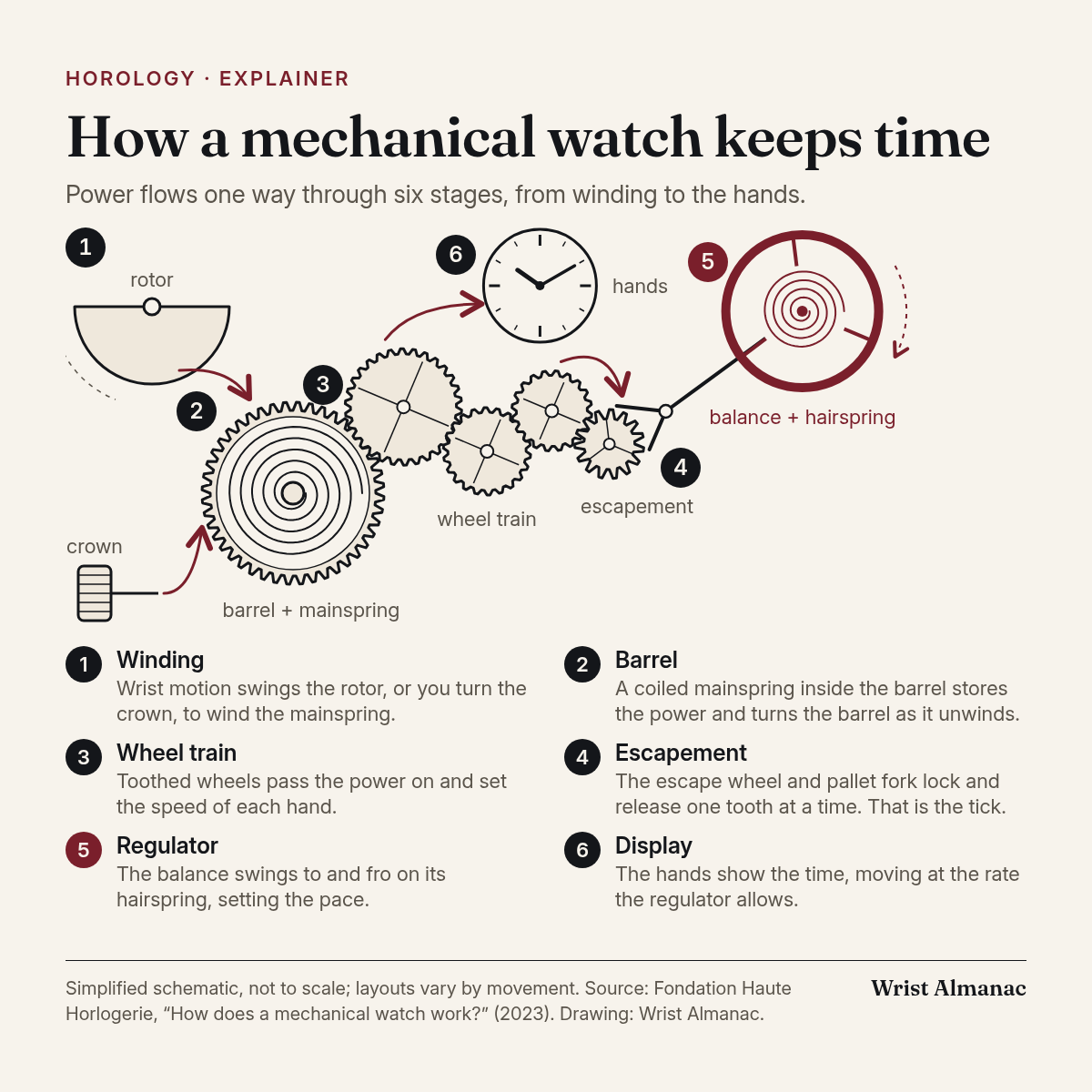
How a mechanical watch keeps time

Power flows one way through six stages (winding, barrel, wheel train, escapement, regulator, display), and the balance wheel sets the pace.

Original line-drawn schematic of a mechanical watch movement, not to scale. Numbered parts: 1, a half-moon rotor and a crown, both winding; 2, the barrel with a coiled mainspring; 3, a chain of three toothed wheels; 4, the escape wheel and pallet fork; 5, the balance wheel with its spiral hairspring, highlighted in oxblood; 6, a dial with hands at 10:10. Oxblood arrows show power moving from the winding parts to the barrel, through the wheels to the escapement, and out to the hands. A key below explains each stage in one sentence.
Every mechanical watch, simple or complicated, runs the same chain. A spring stores power, wheels carry it, and the escapement releases it in small, even steps, paced by the swinging balance. Simplified schematic, not to scale; layouts vary by movement. Source: Fondation Haute Horlogerie, "How does a mechanical watch work?" (2023). Drawing: Wrist Almanac.Fondation Haute Horlogerie ↗